Published November 17, 2026 by Sewer-Jetting.com
If a plumber or drain company has told you that your line needs to be "jetted," you are probably wondering what that means and whether it is worth it. Hydro jetting, also called sewer jetting or water jetting, is one of the most effective ways to clean a drain or sewer line. It is also one of the most misunderstood. This guide explains how it works in plain terms.
Hydro jetting in one sentence
Hydro jetting cleans the inside of a pipe with a stream of high-pressure water from a specialized hose and nozzle, scouring grease, sludge, scale, sand, and roots off the pipe wall and flushing them out of the line.
How a hydro jetter works
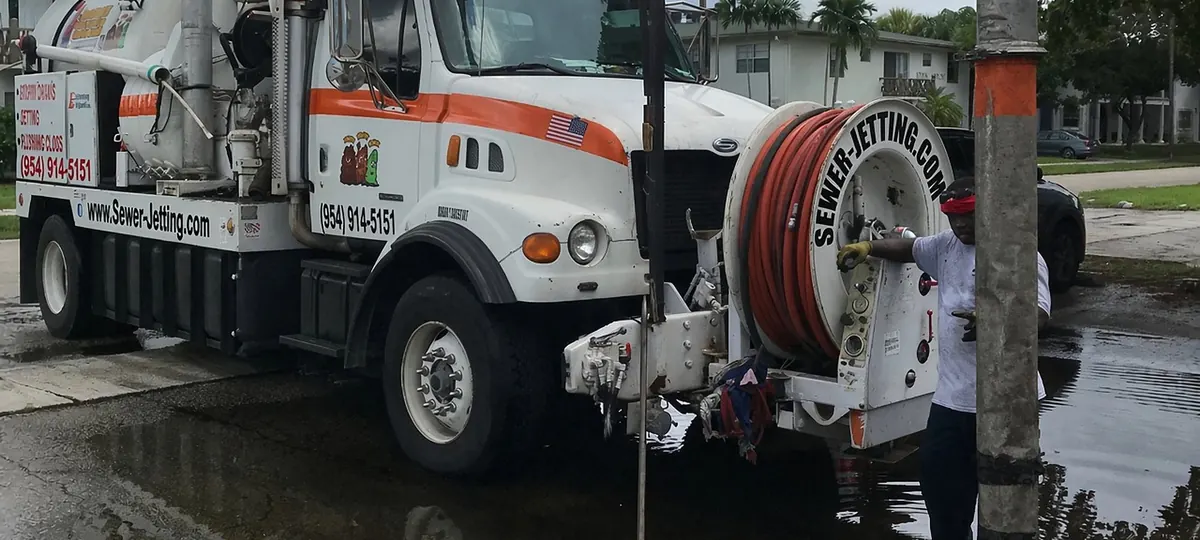
A hydro jetter has three main parts: a pump that pressurizes water, a long high-pressure hose on a reel, and a nozzle on the end of the hose. Jetters range from smaller portable and trailer-mounted units to large truck-mounted systems, and the size of the machine is matched to the size and length of the line.
The hose goes into the pipe through an access point, usually a cleanout. The nozzle has small openings, most of them pointing backward. When water shoots out the back of the nozzle, it pulls the nozzle and hose forward through the pipe, a bit like a jet engine. At the same time, those backward jets hit the pipe wall all the way around. As the operator works the hose forward and back, the water scrubs the full circumference of the pipe and carries loosened debris back toward the access point, where it can be removed.
Nozzles matter
Different nozzles do different jobs. A penetrating nozzle has a forward jet to open a path through a blockage. A flushing nozzle has mostly rear jets to wash sand and sediment back down the line. Root-cutting nozzles use rotating or cutting heads to chew through root masses. Descaling heads help remove scale from older cast iron. Choosing the right nozzle, and the right pressure for the pipe, is a big part of doing the job well.
What hydro jetting removes
- Kitchen and restaurant grease, fats, and oils
- Soap scum and sludge
- Food waste and sanitary debris
- Sand, silt, and sediment, especially in storm and French drains
- Mineral scale and rust buildup in older pipes
- Tree roots, with the right cutting nozzle
Hydro jetting vs. a drain snake
A drain snake, or cable machine, spins a metal cable with a cutting head through a clog. It is fast and effective for many simple clogs, but it opens a hole about the size of the cutter through the middle of the blockage. Whatever was coating the pipe wall stays behind and catches the next round of debris. That is why a line that has been snaked may clog again in a few weeks or months.
Hydro jetting cleans the wall itself. That is why it is usually the better choice for recurring clogs, grease lines, and lines with roots or scale. We cover the comparison in detail in hydro jetting vs. snaking.
Is hydro jetting safe for my pipes?
On pipe that is structurally sound, with the nozzle and pressure matched to the pipe, hydro jetting is a safe way to clean common drain materials, including PVC, cast iron, and clay. The risk comes from jetting a pipe that is already failing: cast iron that has corroded thin, a cracked or collapsed clay line, or a badly separated joint. High-pressure water will not fix those problems and can make them worse.
That is why a sewer camera inspection should come first whenever the line can be seen. The camera shows what is in the pipe and the condition of the pipe itself, so the right decision can be made before any pressure goes in. A second camera pass afterward shows whether the pipe is actually clean.
When hydro jetting is the right tool
- A main sewer line that clogs again and again in the same place
- Slow drains in several fixtures at once
- Restaurant and commercial kitchen grease lines
- Roots in a sewer lateral
- Older cast iron with heavy scale (sometimes with descaling)
- Storm drains, catch basin outlets, and French drains full of sand and silt
- Preventive maintenance on lines with a history of trouble
When hydro jetting is not the answer
Jetting cleans pipe; it does not repair it. It will not fix a collapsed section, a badly offset joint, a pipe that has rotted through, or a belly (sag) in the line that holds water. If the camera shows one of those conditions, cleaning may still help diagnose the problem, but the long-term fix is a repair. An honest contractor will tell you that instead of selling a jetting job that cannot solve the problem.
A single, simple clog, such as hair in one bathroom sink, also may not need jetting at all. Standard drain cleaning is often enough.
What to expect during a hydro jetting visit
- Questions first. Which fixtures are affected, how often it happens, and how old the building is.
- Access. Find the cleanout or other access point. Jetting is done from inside the pipe, so it does not require digging when there is a usable access point.
- Camera inspection when the line can be seen.
- Jetting with the right nozzle and pressure, working the full length of the line.
- Verification with a second camera pass when possible, and a conversation about what was found.
How long does hydro jetting last?
It depends on what caused the problem. A line that was clogged by years of grease buildup and is then used carefully can stay clear for a long time. A line with roots coming through an open joint will usually see the roots return, because jetting clears the pipe but does not seal the joint. Restaurant grease lines build up again at a rate that depends on the kitchen. The camera footage from each cleaning is the best guide to how often your line needs attention.
Hydro jetting in South Florida
South Florida has its own mix of drain problems: grease-heavy restaurant districts, older cast iron under slab homes, mature trees and palms near sewer laterals, and sand and heavy rain that load up storm drains and French drains. We provide hydro jetting for homes and businesses in Fort Lauderdale, Boca Raton, West Palm Beach, and across Miami-Dade, Broward, and Palm Beach Counties. Call (954) 914-5151 to talk through your line.